
How to Improve Window Thermal Performance
02/14/2022
Many buildings have issues with climate control and thermal comfort. Between summer humidity and sun and cold winter winds, windows are a key consideration for controlling a building’s thermal performance. When selecting windows, it’s important to consider the entire window system, from the frame to the glass.
How Window Frames Improve Thermal Performance
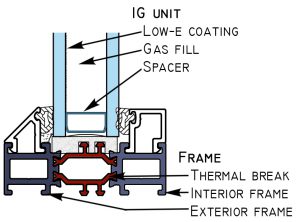 With the frame, the key is reducing the thermal transfer between the outside and the inside.
Commercial aluminum-framed fenestration systems are one of the most common types of windows in commercial buildings. Aluminum is very strong and is often selected for very large window openings because it can support a lot of weight. However, aluminum is a highly conductive material and requires thermal breaks to effectively stop heat, or cold, from traveling from one side to the other. The commercial aluminum-framed fenestration systems are usually thermally broken using either an extruded polyamide strip or a pour-and-debridge method.
Polyamide strips are the most common method to separate interior and exterior profile assemblies. The profile is designed with a series of small ridges or grooves to hold polyamide strips in place. Polyamide slides into these pockets and is crimped into place creating a solid structural connection. Polyamide expands and contracts similarly to aluminum, creating a durable thermal system.
The pour-and-debridge involves a two-part polyurethane mixture poured into an aluminum channel, allowed to cure, and then debridged, or thermally separated, by cutting the aluminum extrusion into interior and exterior assemblies.
How Window Glass Improves Thermal Performance
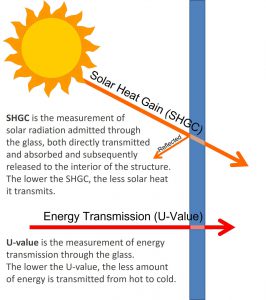 The glass is also a key component of thermal performance and controlling the solar radiation and thermal transition through it.
Insulating Glazing units, or IGs, refer to windows with two or more panes of glass. IGs are available in a wide range of properties based on the type of glass selected, the coatings on the glass, the gas used to fill the space between the panes, and the spacers that keep the glazing separated. Insulated window glazing primarily lowers the U-value, but it also lowers the solar heat gain (SHGC).
Low-emissivity (low-E) coatings on the glass control heat transfer within the IG. A low-E coating is a microscopically thin, virtually invisible, metal or metallic oxide layer added directly on the surface of one or more of the panes of glass. The low-E coating lowers the U-value of the window and manages the daylight transmittance as well as the SHGC through the glazing system.
How Window Gas Fills and Spacers Improve Thermal Performance
To minimize heat transfer between the interior and exterior panes of glass, the space between glazing layers is filled with argon or krypton gas; both are inert, non-toxic, clear, and odorless. Argon and krypton occur naturally in the atmosphere and can help improve thermal performance.
Spacers with associated sealants are used to keep the layers of glazing the correct distance apart and accommodate for thermal expansion and pressure differences, while also preventing moisture and gas leaks. Spacers can be and are designed to lower the window U-value and reduce condensation at the edge of the window
Carefully selected components can influence the thermal performance of not only the complete fenestration system but also the entire building. Using thermally improved systems ensures a comfortable inviting building and is a valuable asset for building owners. To learn more about how aluminum window frames improve thermal comfort, contact our window experts today.