
Key Curtain Wall Design Loads to Consider
11/25/2019
Curtain wall systems, no matter the scale, are complex projects that require careful planning. Five key curtain wall design load considerations are structural integrity, weather-tightness, sound control, energy efficiency, and provision for movement.
Steven Saffell of Glass Magazine gives an in-depth rundown on what these design loans mean, and how to account for them:
Structural integrity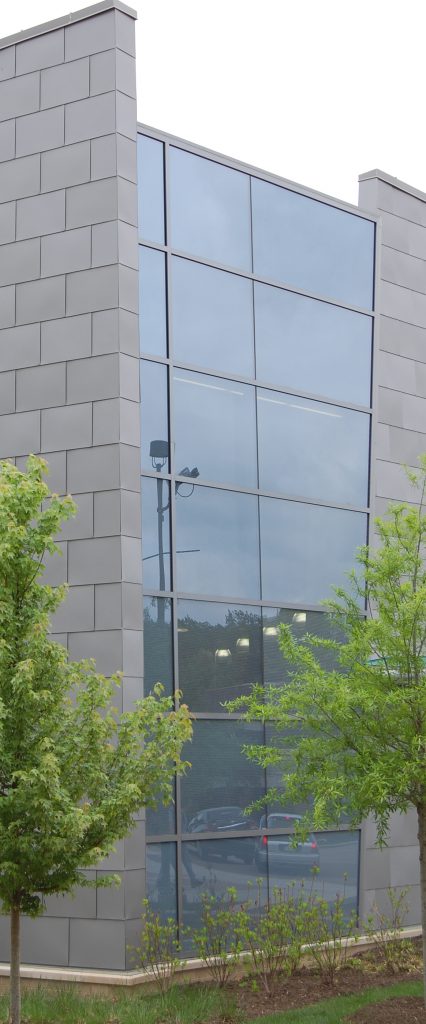
As with all types of fenestration, lateral wind forces are the primary live loads affecting curtain wall structural integrity. The different design wind loads at different building heights and at areas adjacent to the building corners must be taken into account, as well as both positive (inward acting) and negative (outward acting) loads. Appropriate design wind loads for most situations are typically derived from ASCE/SEI 7, Minimum Design Loads for Buildings and Other Structures.
A related consideration is the deflection of glass-supporting frame members, typically limited to L/175 (where L is the span length), to avoid excessive stress on the glass that could lead to breakage.
A third consideration is providing for movement due to differential thermal expansion or contraction between aluminum and glass. This disparity must be accommodated without causing undue stress on glass, joints, and anchors, or reducing glass “bite.”
Weather-tightness
Two methods have been developed for preventing water penetration through the curtain wall. One is the “internal drainage” system, wherein minor leakage can be prevented by providing flashing, collection devices, and ample drainage outlets within the wall itself. The other is the “pressure equalization” method, based on the “rain screen principle,” which requires a ventilated outer wall surface, backed by drained air spaces in which pressures are maintained equal to those outside the wall.
Sound transmission
In terms of sound transmission, the weak links in most walls are the glazed areas. Insulating glazing units with laminated glass generally improve sound attenuation. Where a high degree of sound insulation is required, air infiltration and resonance of rigidly supported glass lites should also be minimized.
Energy efficiency
Although metal and glass have high heat conductance, improving thermal performance can be accomplished by minimizing the proportion of metal framing members exposed to the outdoors, eliminating thermal short circuits by means of thermal breaks, using high-performance IG units, and providing adequate insulation in spandrel areas.
In addition, the large glazed areas allow natural light to penetrate deeper within the building to save energy by supplanting electric lighting while minimizing solar heat gain through the use of low-emissivity coatings. In addition, multiple studies have shown that, by connecting people to their environment, fenestration with views improves attitudes, increases productivity, and provides ventilation to improve indoor air quality.
Building tolerances
The terms “tolerance” and “clearance” are often confused. Tolerance is a permissible deviation from a specified or nominal characteristic; in general, tighter tolerances equal higher costs. Clearance is the space purposely provided between adjacent parts, to allow for movements, anticipated size variations, or to provide installation working space. Both are critical, because covering a field-constructed skeleton with a factory-made skin, involving the work of numerous trades, introduces numerous sources for variation.
Allowances for dimensional tolerances and proper clearances are of particular importance in the detailing of glazing frames, where ample edge clearance and sufficient bite are prime factors affecting glass performance. Glass-holding members must also provide openings that are within certain tolerances for squareness (expressed as the difference between the measured lengths of the diagonals, which should not exceed 1/8-inch), corner offset, and bow.
Industry-recommended curtain wall system tolerances are available for framing and trim dimensions and for alignment of framing members (end-to-end, variation from plane, and joint gap width).
Keep these guidelines in mind when designing and planning a curtain wall. Get more information about our SCW 9000 series or request a quote to get started.