
How to Measure the Sound Transfer of Outdoor Sounds
08/16/2022
 Urban noise can be one of the greatest challenges in designing buildings in the city landscape. Unfortunately, it is often overlooked and later deeply regretted. Attenuation considerations are essential for buildings situated near rail tracks, major highways, or commercial airport operations. Other noise-sensitive applications include hospitals and schools where external noise can be disruptive, distracting, and unhealthy.
The Outdoor/Indoor Transmission Class (OITC) rating system was designed to specifically measure the sound transfer of outdoor sounds (horns, sirens, planes, construction, garbage collection, and more) to interior spaces through exterior walls, windows, doors, and other façade elements. Exterior noise tends to be a lower frequency than interior noise (such as voices), so the OITC rating system focuses on low-frequency sounds.
How is OITC Measured
OITC measures sound intensity loss in decibels. Decibel (dB) is a measure of the amplitude of the sound. The higher the number of decibels, the louder the sound.
So, if a 120 dB traffic noise registers as 80 dB inside the building after traveling through a window or wall, that sound suffers an intensity loss, or deficit, of 40 dB.
The ability of a barrier to create a decibel deficit varies according to the frequency of the sound passing through it. OITC ratings measure data gathered over an 80 to 4000 hertz frequency range and then are calculated in accordance with American Society for Testing and Materials (ASTM) standards.
The higher the OITC ratings, the better the resistance to sound transmission. This means the more significant the difference between the sound transmitted from outside and the sound heard in the building, the better the attenuation.
Understanding Fenestration OITC Ratings
It is important to understand what OITC ratings mean for fenestration products. Sound transmission performance of windows and doors is influenced not only by the glass but also by the framing members and construction of the window assembly.
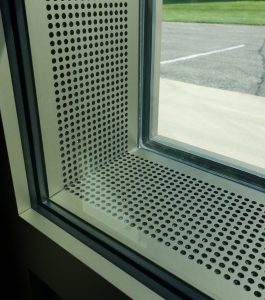 Factors that can influence the OITC rating of a window or door include:
- Mass – Both window frame material and glass should create barriers of sufficient mass to attenuate noise.
- Airspace between multiple glass barriers – An increase in airspace will decrease sound transmission.
- Acoustic decoupling of frame barriers – By changing the material composition of the frame with decouplers, sound transmission is reduced. With fenestration products, this is accomplished by the thermal barrier and other components, which affect the sound wave as it traverses the frame.
- Air infiltration through the fenestration assembly – Noise follows air, which means the overall product assembly must have minimal air infiltration. It is inadvisable to estimate attenuation based only on the glass composition; the entire unit, of practical dimensions, must be tested to ascertain its acoustic performance.
Effective use of acoustic windows and doors is essential to keeping urban noise out and creating quiet interior spaces. Look for OITC ratings to find the optimal levels of noise mitigation.
Our acoustic window experts at St. Cloud Window can help you find the best window for your acoustic needs – request a quote today for more information.